Farm Fence Installation in Lawton, OK
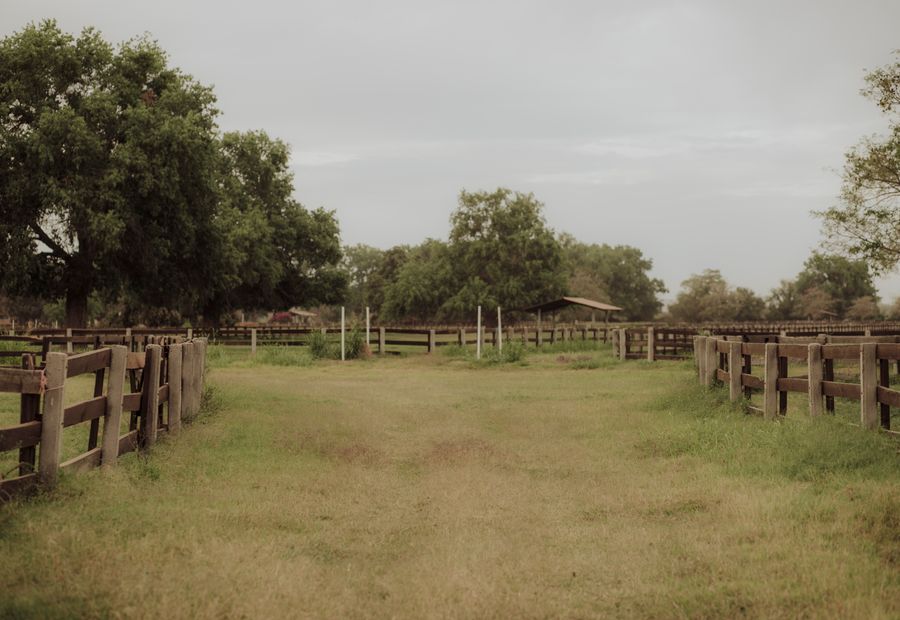
Lawton Farm Fence is a farm fence contractor building welded pipe fence and corrals, woven field fence, high tensile and electric wire, barbed wire, board fence, and ranch gates for cattle outfits, horse places, and wheat ground across Lawton, Cache, Elgin, Fletcher, Sterling, Medicine Park, Walters, Apache, and Indiahoma. We cover Comanche, Caddo, Grady, Stephens, Cotton, Tillman, and Kiowa counties, Oklahoma.
Every strand in a fence pulls toward the end of the run, and the end assembly eats that whole load. So we build an H-brace at each corner, end, and gate opening: two posts, a horizontal rail near the top, and a brace wire wrapped twice on the diagonal and twisted tight. Brace posts measure six to eight inches across and sit three and a half to four feet down. We tamp the backfill in lifts, because packed soil grips the full column of the post, while concrete poured around a treated post traps water at the collar and rots the wood from the middle out. Concrete goes under steel pipe instead. Wire is Class 3 galvanized, roughly three times the zinc of Class 1, and woven fence goes up in Stay-Tuff fixed knot. Gates and panels come from Priefert. Loose wire on driven T-posts with nothing bracing the corner bags out by the second summer.
Pipe Country
Southwest Oklahoma runs on cattle, wheat, and oilfield, and the oilfield left cheap surplus steel behind it. Ranchers welded drill stem and sucker rod into fence and working pens through the boom and bust years, and the habit stuck. Pipe shrugs off a bull that would push a wood rail apart. We weld pipe at pens, lanes, and entrances, and run wire across the open acres.
Granite, Red Clay, and Shallow Frost
The Wichitas are igneous rock, granite and rhyolite and gabbro, and it surfaces well out past the refuge. An auger stalls on it. We drill those holes with a rock bit and set steel where wood will not go. Off the outcrops the ground turns to red iron-stained clay that augers clean but swells and shrinks with the weather. Frost reaches only a foot or so down this far south, so depth here buys grip, not freeze protection.
Spacing, Tension, and Price
Woven and barbed line posts run twelve to sixteen feet apart, closer on rolling ground and anywhere cattle crowd. Driven T-posts go eight to twelve. High tensile smooth wire gets pulled to tension with a ratchet strainer, and a spring on the line reads that tension at a glance. Fence follows the terrain instead of running level over it, with tie-downs in the draws and floodgates where a line crosses water. Pricing runs per linear foot.
Season and Booking
The build season here is long, spring through fall plus much of the winter, since the ground rarely locks up this far south. Saturated clay still stops a job, and we will say so rather than set a post in mud. (580) 555-0139 reaches a real person.
What is the Oklahoma 15-year fence law?
There is no fence statute with that name. People are thinking of boundary by acquiescence. If you and your neighbor both treat an existing fence as the property line, and you both live with it that way for fifteen years, neither of you can later argue the line sits somewhere else. The fence becomes the boundary even when the survey pin says otherwise. That is a survey and attorney question, not a fence question, so pull a current survey before you move a line that has stood a long time.
What is the fence law in Oklahoma?
Oklahoma is a closed range state. The law puts the duty on the livestock owner to keep his animals restrained at all times, so the burden sits with the person running stock rather than the neighbor trying to keep them out. Open range districts were phased out decades ago. If your cattle get on the highway or into a neighbor's wheat, the fence is your problem.
Who pays for a fence between neighbors in Oklahoma?
Start with an agreement in writing. Oklahoma treats adjoining owners as mutually responsible for a boundary fence when both of them use it to hold livestock, and one owner can give the other written notice to keep up his share. The law does not automatically hand your neighbor half the invoice. A neighbor holding his ground open and unenclosed, running nothing, is a different situation. Talk to your county before you count on a split.
What counts as a lawful fence in Oklahoma?
The state describes a lawful fence as three rails or three boards of substantial material on set posts, with the bottom rail sixteen to twenty inches off the ground and the whole fence standing about fifty four inches tall. Barbed wire has its own allowance for three or four wires with stays between the posts. Treat that as the legal floor. A fence that actually holds bulls in Comanche County is built past it.