Barbed Wire Fence in Lawton, OK
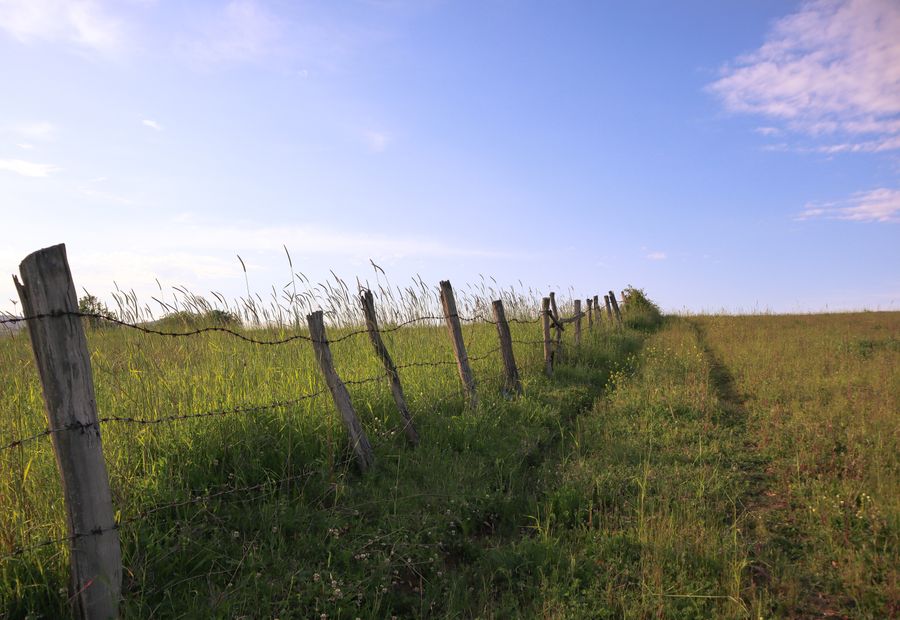
Lawton Farm Fence builds and repairs barbed wire fence on cattle pasture, wheat ground, and section lines throughout Comanche, Cotton, Tillman, and Grady counties. This is cattle fence and only cattle fence. We do not run barbed wire on horse pasture, and we say so before we quote it.
We hang Red Brand barbed wire and Bekaert Gaucho high tensile barbed, both in Class 3 galvanized coating that carries roughly three times the zinc of Class 1. Gaucho lets a lighter roll do the same work, since high tensile barbed holds tension where soft wire gives up early and stays given up. Wire pulls from a braced end, not from a truck bumper, and every strand comes to tension on its own. Corners are H-braces in CCA ground contact treated posts, six to eight inches across, set three and a half to four feet down and tamped in lifts. Splices are wrapped, not knotted, so the joint carries as much load as the run. Wire stretched by feel, tied to a corner post with no brace behind it, is the fence that sags in a season and gets blamed on the cows.
Building for the Closed Range
Oklahoma puts the duty to restrain livestock on the owner of the livestock. That makes a perimeter fence a liability question, not just a grazing one, and it is why we build the outside line heavier than the cross fence. Highway frontage on US 62, US 277, and the roads running out toward Fletcher and Sterling gets tighter post spacing and an extra strand. The state describes a lawful barbed fence with three or four wires and stays between the posts. That is a floor, and a fence built to the floor is a fence you will be repairing.
Rock, Clay, and Terrain
Line posts run twelve to sixteen feet apart on wood, eight to twelve on driven steel. Closer where the ground rolls. West toward Indiahoma and the Wichitas the auger finds granite, and a hole that will not drill gets a rock bit or a relocated post rather than a shallow one. On red clay a tamped post holds well and can be reset later, so we keep concrete out of it. Through the draws we drop tie-down posts at the low points and hang a floodgate wherever the line crosses a creek, since a fence run straight over a dip leaves a gap a calf finds inside a week.
Repairs and New Line
We restretch and rebuild old barbed fence as well as build new. Call (580) 555-0139 and we will drive the line with you before quoting a foot of it.
How many strands does a cattle fence need?
Five is the standard on working pasture here. That puts the top wire around four and a half feet up and the bottom wire about a foot off the ground. Spacing tightens toward the bottom, because calves go under a fence long before a cow goes through it. Four strands will hold quiet mother cows on flat ground. A bull pasture or a fence along a highway gets six.
What is the difference between two point and four point barbs?
The barb count and the spacing between barbs. Four point barbs sit closer together and bite sooner, so they turn stock that lean and test. Two point is easier on hide and on hands and is common on horse-adjacent pasture and interior cross fence. Red Brand sells both, as Ruthless in four point and Defender in two point.
Can I use steel T-posts on the corners?
No. A T-post is driven, not dug, and it holds wire up rather than holding wire back. Every corner, end, gate opening, and hard change of direction needs a wood or pipe brace assembly. T-posts fill the line between them, eight to twelve feet apart. Corners on T-posts are the single most common reason a barbed fence leans.
How much does barbed wire fence cost per foot?
Barbed wire is the cheapest fence per linear foot that will still hold cattle, which is why so much of Comanche County is fenced with it. Terrain and clearing move the price more than the wire does. A clear straight half mile across flat pasture prices very differently from the same footage through mesquite and over rock. Corners are the other cost, because each one is a full brace, not a post.